
Why HVAC Google Ads in Richmond Hill Need a Different Setup Than Most Businesses
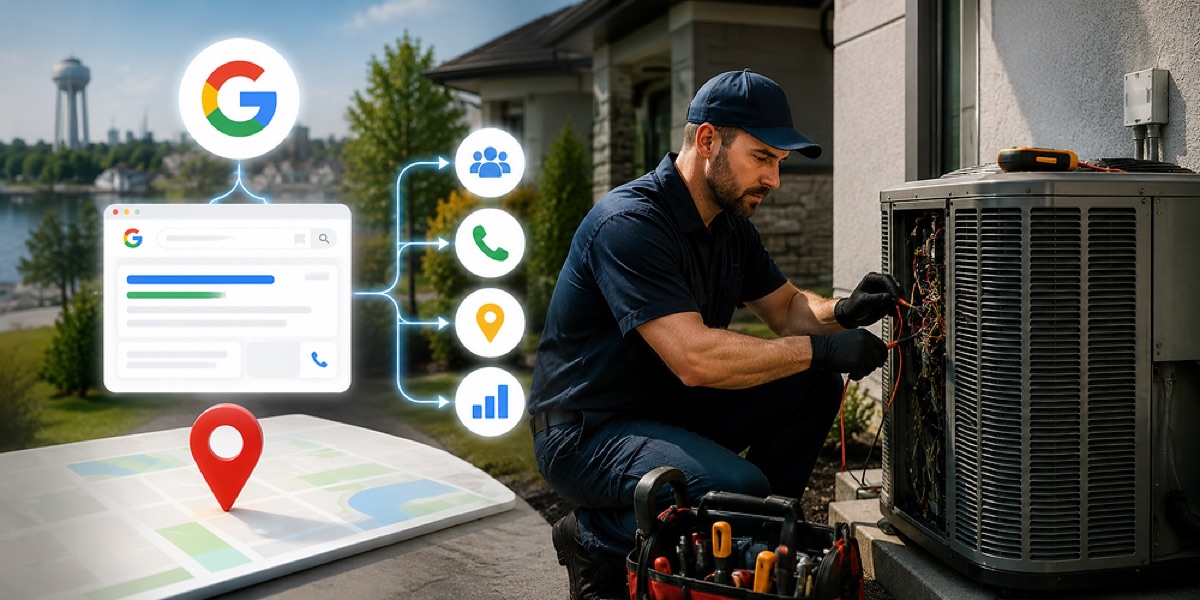
Most Google Ads accounts are built for consideration; someone researching, comparing, maybe converting next week. HVAC doesn't work that way. A no-heat call in February is an emergency, and the person searching wants a phone number in the next ten seconds, not a blog post to read. That means:
- Call extensions and click-to-call are mandatory, not optional. If someone can search, tap, and be talking to a technician in three taps, you win the job before a competitor's site even finishes loading.
- Dayparting matters. Furnace failures spike overnight and on weekends; AC failures spike during heat waves. Bidding the same across all hours wastes money on searches that convert at half the rate.
- Service-specific ad groups beat one big “HVAC” campaign. Someone searching “furnace won't turn on” and someone searching “AC installation quote” are in completely different moods; one is panicking, one is planning. Split them into separate ad groups with separate ad copy so each message matches the intent.
Building the Campaign: Keywords, Structure, Budget
Start with three tightly-scoped campaigns instead of one broad one: Emergency Repair, Installation & Replacement, and Maintenance & Tune-Ups. Each targets a different buyer and a different budget priority.
For a Richmond Hill HVAC company, a realistic keyword split looks like this:
- Emergency repair: “furnace repair richmond hill,” “no heat emergency,” “ac not cooling,” “hvac repair near me”
- Installation: “furnace installation richmond hill,” “new ac unit cost,” “hvac replacement quote”
- Maintenance: “furnace tune up richmond hill,” “ac maintenance plan”
Use exact and phrase match only for the emergency campaign: broad match on “furnace repair” in a market like the GTA burns budget fast on searches for parts, DIY videos, and jobs three cities away. Layer in a tight geo-radius around Richmond Hill (roughly a 15–20 minute drive time, adjusted for how far your trucks actually go) rather than targeting all of York Region at once; a technician who can't reach a job in 45 minutes isn't a lead worth paying for.
Budget-wise, don't split evenly across the three campaigns. Home services keywords already carry a premium cost-per-click industry-wideWordStream's 2026 Google Ads Benchmarks put the Home & Home Improvement category at $8.33 average CPC, well above the $5.42 all-industry average, and emergency repair terms within that category run higher still. Directionally, emergency repair keywords cost more per click and convert faster, so they should get first claim on daily budget, with installation getting the next largest share and maintenance running lean.
Negative Keywords: Where Most HVAC Budgets Leak
Say you run an HVAC company in Richmond Hill and you're not watching your search terms report weekly: you're almost certainly paying for clicks from people looking for jobs (“hvac technician jobs richmond hill&rdquo), DIY fixes (“how to fix furnace myself&rdquo), and parts suppliers (“furnace igniter part number&rdquo). None of those searches want to hire you. Build a negative keyword list covering:
- Job-seeker terms: “jobs,” “hiring,” “careers,” “salary”
- DIY terms: “how to,” “diy,” “myself,” “video”
- Parts and manufacturer terms: specific brand/part numbers unless you sell parts directly
- Free/cheap modifiers if you don't compete on price: “free,” “cheap,” “discount code”
Review the search terms report every week for the first month of a new campaign, then every two weeks once it stabilizes. This single habit is the fastest way to stop paying for clicks that were never going to become a booked job.
Landing Pages: Don't Send HVAC Traffic to the Homepage
A homepage tries to be everything to everyone. An ad clicked from “furnace repair richmond hill” should land on a page that says exactly that: the service, the city, a phone number above the fold, and a short form as backup for people who don't want to call. Match the landing page headline to the ad headline word-for-word where possible; that consistency is part of what Google's Quality Score rewards, and it's also just better for the person who clicked expecting furnace repair, not a general “who we are” page.