NewLife Services
Meta Ads Agency
Facebook & Instagram Ads That Sell
NewLife Marketing is a Meta ads agency in Barrie & Simcoe County: Facebook & Instagram ads run as a full system — creative, a real funnel, audience targeting, ABO testing and CBO scaling.
Stop The Scroll. Turn Attention Into Customers.
We produce the video in-house and run the strategy behind it — objectives, funnel, audiences, ABO/CBO and tracking — so your Meta budget builds a pipeline, not a follower count.
The problem
Boosting Posts Is Not A Strategy
Hitting “Boost” gets you likes from people who'll never buy. Meta is one of the most powerful direct-response machines ever built — but only if you run it as a system: the right objective, a real funnel, deliberate audiences, relentless creative testing and proper tracking.
Most businesses do none of that. They run one ad to a cold audience with no retargeting, no tracking and no landing page, then decide “Facebook ads don't work.” They do — as a system.
What it is
Meta Ads, In Plain English
Meta ads put your business in front of precisely targeted people while they scroll Facebook and Instagram. Unlike Google, where people search for you, on Meta you interrupt the scroll — which means the ad itself has to stop the thumb. That's why creative is everything.
Run properly, it's a full funnel: cold ads introduce you, retargeting closes the people who showed interest, and your CRM follows up automatically. Ads → landing page → follow-up, working as one connected system.
Who it's for
Who Our Meta Ads Agency Works Best For
Any business with something worth watching — a transformation, a product, a story, a face. If you can show it, Meta can sell it.
E-Commerce & Retail
Product video and offers that turn the scroll into a sale.
See the E-Commerce & Retail playbook →Local & Storefront
Fill tables and foot traffic with radius-targeted video.
See the Local & Storefront playbook →Health, Fitness & Wellness
Memberships and bookings driven by transformation and community content.
See the Health, Fitness & Wellness playbook →See it, don't just read it
Real Meta Ads We've Produced
This is a video-ad service, so here's the actual product. Every tile is a real ad we filmed, edited and ran — tap any one for sound.
Table of contents
What’s In This Guide
Eighteen chapters: what Meta Ads are, the six things an account has to get right, and exactly how we run each of them for you.
- 01You Are Competing For Two Seconds
- 02Meta Ads, In Plain English
- 03The Six Pillars
- 04Pillar 1 — Tracking Comes First
- 05Pillar 2 — Targeting Changed In 2026
- 06Pillar 3 — Budget Follows Proof
- 07Pillar 4 — Creative Is The Targeting Now
- 08Pillar 5 — Every Ad Set Gets A Verdict
- 09Pillar 6 — The Cheapest Revenue In The Account
- 10Who It Is For — And Who It Is Not
- 11What Meta Ads Actually Change
- 12The First 90 Days
- 13What Is Included
- 14What We Report — And What We Refuse To
- 15The Five Most Common Meta Ads Mistakes
- 16The Tools We Actually Use
- 17Who Runs Your Account
- 18Proof — Elite Cards Toronto
The problem
You Are Competing For Two Seconds
Before any of the mechanics, the thing most Meta budgets are actually losing to.
Boosting posts
It feels like advertising and it is not. No campaign objective, no audience strategy, no conversion event — money spent buying engagement that never becomes a sale.
The agency that reported reach
Monthly reports full of impressions, reach and engagement, with no line connecting any of it to revenue. The numbers went up. The bank account did not.
One ad, run forever
The ad that worked in month one is still the ad in month six. Frequency climbs, performance decays, and nobody swapped the creative.
Stopping at two weeks
Killed before the learning phase finished, so the account never accumulated the conversion data the algorithm needs to get cheaper.
The real constraint
Nobody opens Instagram wanting to see your ad. The feed is the competition — the photos, the messages, the videos someone actually came for. You are not competing with other advertisers for attention. You are competing with everything else on the screen for about two seconds.
Which is why the creative matters more than the targeting, and why the four approaches on the left all fail for the same underlying reason.
What it is
Meta Ads, In Plain English
One level deeper than most agency pages go — because every later section refers back to it.
The Pixel, the API and the auction
The Meta Pixel reports what happens on your site. The Conversions API reports the same events server-side, so they survive ad blockers and browser restrictions. Event Match Quality is how confidently Meta can tie an event to a real person — and better matching means cheaper results, not a vanity score.
The auction is the part most people picture wrongly. You are not outbidding competitors for a slot. Meta is scoring how likely each person is to do the thing you asked for, and cheap results come from being relevant, not from bidding harder.
Six beliefs about Meta Ads that are reasonable, and wrong
“Meta Ads do not work for my industry”
Usually it is not the platform — it is that the offer, the creative or the tracking was never built for it. That said, some businesses genuinely are a poor fit, and that list is further down this page.
“We tried it and it was expensive”
Most accounts we audit were stopped inside the learning phase, or were fragmented across so many small ad sets that none of them ever exited it. The cost per result was real; the conclusion drawn from it was not.
“We just need better targeting”
Detailed interest targeting was deprecated in January 2026. Targeting is no longer the lever most people think it is — the creative is.
“Boosting is basically the same thing”
A boosted post cannot optimise for a purchase or a qualified lead, because it has no conversion objective. It is buying engagement, which is a different product.
“ROAS is profit”
Platform ROAS is Meta's own reported conversion value divided by spend. It is not audited revenue and it is not de-duplicated across channels. Useful as a direction, dangerous as a P&L line.
“We will know in a week”
You will know something in a week — usually whether the tracking works. Whether the campaign is profitable takes longer, and pretending otherwise is how good accounts get killed early.
The model
The Six Pillars
All six are load-bearing. Skip one and the other five underperform — which is why each gets its own section below.
Tracking & infrastructure
Pixel, Conversions API, event setup
Audience & targeting
Broad, Advantage+ and first-party data
Campaign architecture
Prospecting, scaling, retargeting
Creative production
Filmed in-house, queued continuously
Testing & scaling
Every ad set gets a verdict
Retargeting & retention
The warm pool, segmented by intent
Tracking
Pillar 1 — Tracking Comes First
The foundation nobody sees and everything depends on.
Meta Pixel, Conversions API, custom conversions, event setup, and the attribution windows every number later gets reported against.
They install the Pixel and call tracking done. Browser-only tracking loses a large share of events to ad blockers and browser restrictions — so the algorithm is optimising on partial data, and nobody mentions it.
Pixel and Conversions API together, server-side, so events survive. Then we push Event Match Quality by passing more customer parameters, so Meta can actually match an event to a person. Nothing launches until tracking is verified working.
Audience
Pillar 2 — Targeting Changed In 2026
This is the section that shows whether an agency is current. Most competitor pages still describe interest stacking that stopped working in January.
What changed
Meta deprecated detailed interest targeting on 15 January 2026. Interest audiences built before October 2025 stopped delivering. Any account still structured around stacked interest layers is running on something that no longer works.
Who the ads reach — and in 2026 that is mostly a question of what data you feed Meta, not which boxes you tick.
Five ad sets split by interest at a few dollars a day each. Meta cannot learn from that, the ad sets bid against each other for the same people, and none of them ever exits the learning phase.
Fewer, broader ad sets with enough budget to exit learning, seeded with real first-party data — customer lists, purchase events, high-value segments. Lookalikes built from your best customers, not your whole buyer file. Meta reports its Advantage+ Audience delivering around 15% lower cost per result on awareness objectives; that is Meta's own figure, not ours.
Architecture
Pillar 3 — Budget Follows Proof
The core mechanism, and the one prospects remember: nothing gets budget for being new, and nothing gets killed for being expensive — only for being unproven.
How an ad set graduates
Every ad set starts in prospecting — new audience, unproven creative, a deliberately small daily budget. It stays there until it has produced enough data to judge. If it proves out, it is promoted into scaling or retargeting and given real budget. If it does not, it is cut.
Either way a new ad set enters prospecting behind it, so the top of the system is never empty.
We do not fragment into ten campaigns at a few dollars a day, and we leave three to five days between structural changes rather than reacting daily.
Creative
Pillar 4 — Creative Is The Targeting Now
The single most important argument on this page, and the one we can back with a crew rather than a claim.
Why this is literally true in 2026
With detailed targeting gone and broad audiences the default, the creative decides who Meta shows the ad to. The algorithm reads who responds and goes to find more of them. Creative is no longer decoration on top of targeting — it is the targeting.
Healthy cold-prospecting frequency sits around 1.5 to 2.5 per week; past 3.0 performance decays. Without new creative queued, there is nothing to rotate in when that happens.
Most agencies outsource creative or run stock. We film it. That is why we can raise creative count without raising campaign count — the constraint that stops most accounts scaling.
The ads themselves — video, stills and design, produced on our own shoot days and cut into multiple formats and variations.
They run one ad until it dies, because producing the next one means another vendor, another quote and another three weeks.
A standing creative pipeline from our own shoots, with new variations entering prospecting continuously — so there is always something fresh to promote the moment an ad fatigues. The same shoot day also feeds your organic content, so the production cost is shared.
Service explainer
Show exactly what you do and why it's better.
Before / after
The transformation — the most persuasive proof in the trades and beauty.
Testimonial
A real customer in their own words beats any script.
Offer ad
A clear promotion with a deadline and a reason to act now.
Founder / owner
You on camera — trust travels faster from a face than a logo.
Project showcase
Your best work, filmed cinematically.
Educational
Teach one thing well and you earn the follow and the click.
Retargeting
A tailored nudge for people who already visited.
Recruitment
Ads that fill roles, not just sell — hiring is marketing too.
Launch
Build anticipation around a new product, location or season.
Testing
Pillar 5 — Every Ad Set Gets A Verdict
How the kill-or-scale call actually gets made, so budget moves on evidence rather than on how the week felt.
The decision process that moves budget — what data threshold we wait for, and what happens at the end of it.
They judge on day two, react to noise, and restart the learning phase every time they touch the account.
We wait for enough conversion data to mean something, then give every ad set an explicit verdict: promote or cut. Structural changes are spaced three to five days apart so each change can actually be attributed to something.
Retargeting
Pillar 6 — The Cheapest Revenue In The Account
Retargeting consistently returns the highest reported ROAS of any campaign type — and that number is also the most misread on the platform.
Segment by intent tier
A cart abandoner and a blog reader are not the same person and should not see the same ad. Lumping all warm traffic together is the most common retargeting mistake.
Video-view retargeting
Someone who watched 75% of a brand video is warm whether or not they ever hit the site. Consistently underused, and cheap to reach.
The honest caveat
If retargeting ROAS looks three times better than prospecting, check audience overlap before celebrating. It is often inflated by the same people seeing both.
Qualify yourself out
Who It Is For — And Who It Is Not
Naming who should not buy is what makes the rest of this page worth reading.
Meta Ads fit when
- You have something visual to show — Product, space, transformation, process.
- Your customer buys on impulse or emotion as much as research — Meta is a discovery channel, not a search one.
- You can service more work than you currently get — Demand generation is cruel to a business at capacity.
- You can commit past the first 30 days of learning — The account gets cheaper as it accumulates conversion data.
It is the wrong call when
- You need leads this week and have no tracking installed — We would be guessing, and you would be paying for the guess.
- Your margin cannot absorb a learning period — The first weeks buy data. If that spend has to return immediately, this is the wrong tool.
- Nobody can describe who the customer actually is — Broad targeting still needs a first-party signal to learn from.
- Your follow-up is broken — Fix the CRM first — otherwise you are paying to generate leads nobody answers.
Selling to other businesses rather than consumers? Meta can still work, but the channel built for a named buying committee is LinkedIn Ads.
The benefits
What Meta Ads Actually Change
Each stated with the mechanism behind it, so you can judge whether it would apply to your business rather than take it on faith.
Demand you create, not just demand you capture
Search only reaches people already looking for you. Meta reaches people who did not know you existed — which is the only way to grow a category that nobody is searching yet.
Speed
Unlike SEO, a campaign can produce results in the first week. This is the honest counterpart to our SEO page, which tells you to come back in six months.
The creative doubles as organic
The same shoot day feeds your ads and your social content, so the production cost is shared across two channels rather than charged to one.
The audience compounds
Every person who watches, clicks or visits becomes retargetable. The account gets cheaper to run as the warm pool grows — which is why stopping and restarting is so expensive.
Precision at the spend level
Cost per result by ad, by audience, by placement — and the ability to move budget accordingly, weekly.
The process
The First 90 Days
What actually happens, week by week, and what it is reasonable to expect at each stage.
1 · Strategy & offer
We pin down the objective, the offer and the funnel before we touch the ad account.
2 · Creative production
Our crew films and edits the ads — the biggest lever gets the most attention.
3 · Tracking & build
Pixel + Conversions API, custom conversions, then campaign structure built ABO-first for testing.
4 · Test with ABO
Multiple audiences and creatives tested with controlled budget to find winners.
5 · Scale with CBO
Proven winners moved into CBO campaigns so Meta pushes budget to the best performers.
6 · Retarget & report
Warm-audience retargeting layered on, with clear monthly reporting on cost per result.
The honest version
The first weeks buy data, not profit. Anyone promising profitable day-one return on ad spend is describing luck, not a process.
What we will commit to is that nothing launches until tracking is verified, that you will see verdicts rather than vague optimism at the end of the first month, and that month three is steered by evidence rather than by assumption.
The scope
What Is Included
The full scope of a Meta Ads engagement — what we build, what we run and what you receive each month.
Account & tracking setup
Pixel and Conversions API installed server-side, custom conversions, event testing, attribution windows agreed and documented.
Audience build
First-party customer lists uploaded and hashed, value-based and lookalike audiences, exclusions so you are not paying to reach existing customers.
Campaign architecture
Prospecting, scaling and retargeting built as separate campaigns with a graduation rule, not ten ad sets fighting each other.
Creative production
Filmed by our own crew on your site — video, stills and design, cut into multiple formats and variations rather than one hero ad.
Weekly optimisation
Budget reallocation, ad set verdicts, creative rotation, and audience adjustments against cost per result.
Creative queue
New variations entering prospecting continuously, so there is always something fresh to promote when an ad fatigues.
Retargeting programme
Segmented by intent tier — site visitors, video viewers, cart abandoners and past customers treated as different people, because they are.
Reporting
Monthly reporting plus a live dashboard, with the platform named and the attribution window stated on every number.
- Objective and full-funnel campaign strategy (prospecting → retargeting → retention)
- In-house video and static ad production with our cinema crew
- Ongoing creative testing — hooks, formats and angles
- Audience building: custom, lookalike and broad / Advantage+
- ABO testing structure and CBO scaling structure
- Meta Pixel + Conversions API tracking setup
- Custom conversions and attribution configuration
- Retargeting campaigns across site, video and engagement audiences
- Landing pages wired into your CRM for instant follow-up
- Weekly optimization against cost per result
- A/B testing of creative and audiences
- Monthly plain-English reporting on spend, leads and ROAS
Measurement
What We Report — And What We Refuse To
The half of reporting most agencies leave out, which is the half that tells you whether to trust the rest.
What we report
- Cost per result, by ad and by audience
- Spend against reported conversion value, with the platform named
- Frequency and creative fatigue
- Which ad sets graduated, and which we cut
- The attribution window, stated on every view
What we refuse to report as a result
- Reach and impressions — if the number can rise while the business gets nothing, it is activity
- Platform ROAS presented as profit — it is Meta’s own reported value divided by spend, not audited revenue and not de-duplicated across channels
- Engagement on a conversion campaign — likes on an ad meant to sell are not a result
- Cherry-picked windows — same report, same sections, every month, including the parts that got worse
Read before you spend
The Five Most Common Meta Ads Mistakes
Every one of these turns up in accounts we audit, and none of them is the platform's fault.
Boosting posts instead of running campaigns
No objective, no conversion event, no structure. The money buys engagement and the engagement buys nothing.
Ten campaigns at a few dollars a day
Budget fragmented so thin that no ad set ever exits the learning phase, and the ad sets end up bidding against each other for the same people.
Still running on interest audiences that stopped delivering
Detailed interest targeting was deprecated on 15 January 2026. Accounts still structured around stacked interest layers are built on something that no longer works.
One ad running until frequency kills it
With nothing queued behind it, there is nothing to rotate in when performance decays — so the account has no way back up.
Browser-only Pixel with no Conversions API
Optimising on partial data and reporting it as complete. The algorithm learns from what it can see, and it is not seeing all of it.
The stack
The Tools We Actually Use
Six tools, and an honest note about the ones we deliberately do not use.
Meta Ads Manager
Where the work happensCampaign structure, budgets, audiences and the reporting we read every week. No third-party dashboard sits between us and the account.
Meta Events Manager
Tracking verificationPixel and Conversions API health, event match quality, deduplication and test events. This is where we prove tracking works before anything launches.
Your CRM
Where a lead becomes revenueUsually GoHighLevel for our clients. Leads land here with their source attached, so cost per booked job can be traced rather than assumed.
Adobe Premiere & After Effects
The creative pipelineOur own post-production, which is why creative volume is not a bottleneck and why a shoot day turns into a month of variations.
Google Analytics 4
The cross-checkA second, independent read on what happened after the click — so we are never reporting only what Meta says about Meta.
NewLife Reporting
Your view of itOur own dashboard, refreshed as the month runs, with the platform named and the attribution window stated on every number.
What is not on this list
Third-party bid-management and “AI optimisation” layers. On the account sizes we run, they add cost and a layer of abstraction between us and the auction without adding decisions we could not make ourselves. If your spend ever reaches the point where one earns its licence fee, we will say so.
Accountability
Who Runs Your Account
The named person accountable for the spend.
Cruz Lee — Founder & Head of Paid Media
Paid media is not handed to a junior here. Cruz built the agency on Meta campaigns for local businesses, camera in hand, and still runs the paid side of the accounts personally.
That matters mostly for one reason: the person deciding which ad set gets budget is the same person who was on the shoot, so creative direction and media decisions are not negotiated between two vendors with different incentives.
You will have his direct number. Questions about your account go to him, not into a ticket queue.

Proof
Proof — Elite Cards Toronto
The number first, then what we changed and in what order — because the method is the part we would repeat for you.
Platform-reported purchase value from the Meta account, March to July 2026, on $6.05K of spend. Reported value is what Meta attributes — we show it as that, and we never add it to the Google figure to make a bigger one.
- First
- One ad set in March 2026, broad targeting, with the Conversions API verified before spend went up.
- Then
- Audience segmentation into new, existing and engaged — three ad sets, each judged on its own cost per purchase rather than a blended account average.
- Then
- Geography: Toronto radius first, then Montreal and British Columbia, once the creative was proving itself in the home market.
- Throughout
- Creative supply. Live card-break clips and reels, cut in-house and queued continuously, because on Meta the creative is the targeting.
- Where it stands
- Five ad sets, 4,417 purchases and $736K in platform-reported purchase value on $6.05K of spend.
A live account, not a mock-up
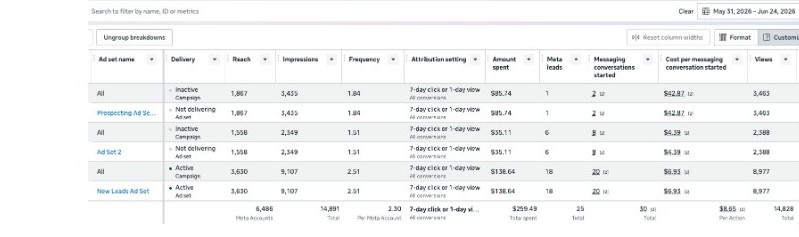
Every dashboard on this page other than this one is an illustration. This is not — it is a live Meta Ads Manager view from a different client account.
Real Meta Ads Manager — a live campaign we run for Aaron's (Thunder Bay).
Straight answers
Meta Ads FAQ
The questions we get before every Meta engagement — including budget and the ABO-vs-CBO one — answered straight.
Did Meta really remove interest targeting?
Detailed interest targeting was deprecated on 15 January 2026, and interest audiences built before October 2025 stopped delivering. Accounts still structured around stacked interest layers are running on something that no longer works. The replacement is broad targeting and Advantage+ Audience fed with your own first-party data — customer lists, purchase events and high-value segments — which is a genuinely different way to build an account.
How fast will Meta Ads work?
Faster than SEO and slower than most agencies imply. You can see results inside the first week, but the first two to four weeks are the learning phase and they buy data rather than profit. Verdicts on the first ad sets land at the end of that window, and month three is where decisions get made on evidence rather than assumption. Anyone promising profitable day-one return is describing luck.
What budget do we need to start?
Enough for the ad sets to exit the learning phase rather than starve in it — which depends on your conversion event, your price point and how competitive your category is locally. We scope it on the call against what a customer is worth to you, and we will tell you if the number that makes sense is higher than you were expecting.
Is ROAS the same as profit?
No, and this one costs people real money. Platform ROAS is Meta's own reported conversion value divided by spend. It is not audited revenue, it is not de-duplicated against your other channels, and it does not know your margins. We report it because it is directionally useful, always naming the platform and the attribution window — but we will not present it as profit.
Can you just boost our posts?
We can, and we would rather not. A boosted post has no campaign objective and no conversion event, so it cannot optimise toward a sale or a qualified lead — it optimises toward engagement, which is a different product. If reach on a specific post is genuinely the goal, boosting is the right tool; for revenue it is not.
Do you make the creative, or do we?
We film it. Our own crew shoots on your site and cuts it into multiple formats and variations, which is the reason we can keep new creative entering prospecting continuously. Most agencies outsource this or run stock, and that is the constraint that stops their accounts scaling.
What is the Conversions API and do we need it?
The Pixel reports conversions from the browser, where ad blockers and browser restrictions lose a large share of them. The Conversions API reports the same events server-side so they survive. Running both, deduplicated, means the algorithm optimises on more complete data — which is cheaper results, not a technicality. Yes, you need it.
How often do you change things?
Weekly for budget and creative rotation; structural changes are spaced three to five days apart. Reacting daily restarts the learning phase and makes every change impossible to attribute. Judging an ad set on day two is judging noise.
Who owns the ad account and the creative?
You do, both. The ad account stays in your business name with us added to it, and the finished creative plus the raw footage are yours during and after the engagement. Nothing is held to make leaving harder.
Should we run Meta Ads or SEO?
Different jobs. Meta creates demand from people who did not know you existed and can move this month; SEO captures demand that already exists and compounds over quarters. If you need results inside 60 days, start here. If you want an asset that keeps paying after you stop spending, read our SEO page. Most of our clients eventually run both, in that order.
What happens if it does not work?
We tell you, with the data, rather than reporting reach and hoping you do not notice. Sometimes the answer is that the offer or the follow-up is the constraint rather than the ads, and we would rather say that than keep billing. If Meta is genuinely the wrong channel for your business, that conversation happens on the strategy call, not in month six.
Do you work with businesses outside Ontario?
The ad management, tracking and reporting are location-independent and run the same anywhere. Production is where distance costs something — we travel for shoot days and quote the travel plainly rather than burying it.
How much should I budget for Meta ads?
Plan for two things: ad spend plus our management and creative. Spend needs enough room to test audiences and creative properly, but the right level — and our fee — is genuinely different per client and package, so we don't publish set rates. You'll get a real number for your goals on the call.
What's the difference between ABO and CBO?
ABO sets the budget at the ad-set level, giving tight control — we use it to test audiences and creative with guaranteed spend on each. CBO sets the budget at the campaign level and lets Meta send it to the best performers — we use it to scale winners. In short: test with ABO, scale with CBO.
Do you make the video ads or do I?
We do. Our in-house crew films and edits everything — that's the whole point. On Meta, creative is the single biggest lever, so we don't leave it to stock footage or a freelancer. See Creative Production.
Facebook or Instagram — which one?
Both, from one account. Meta places your ads across Facebook, Instagram, Reels, Stories and Messenger, and we let the data decide where your budget performs best rather than guessing.
Why do I need retargeting?
Most people don't buy the first time they see you. Retargeting re-engages the people who already visited, watched or engaged — they convert at a fraction of cold-audience cost, so it's usually where the profit is.
How soon will I see results?
Meta needs a short learning phase — expect the first 1–2 weeks to gather data, with clearer signal by weeks 3–4. The compounding gains come as we test creative and move winners into CBO over the first 60–90 days.
What is the Conversions API and why does it matter?
Since iOS privacy changes, the Pixel alone misses conversions. The Conversions API sends event data server-side so Meta can still optimize and you can trust your reporting. We set both up together.
Who owns the ad account and the creative?
You do. Ads run in your Business Manager, and you keep the footage and assets we produce. Nothing is held hostage if we part ways.
Why NewLife
You, In-House, Or A Typical Agency
Everything we do runs on one system we call The Film-to-Funnel System — in-house film → paid ads → landing page → CRM follow-up → optimize. Here's how that stacks up against doing it yourself or hiring a typical agency.
| In-house | Typical agency | NewLife | |
|---|---|---|---|
| Creative | You film it on a phone | Outsourced or stock footage | Our in-house cinema crew, filmed on-site |
| Who does the work | You, between running the business | A junior account manager | Cruz and the senior team, directly |
| The system | Disconnected tools that don't talk | Ads, then hands-off | Film → ads → landing page → CRM, one connected system |
| Your accounts & data | Yours — but no time to run them | Often held hostage | Always yours — you keep everything |
| Follow-up | Manual, when you remember | Rarely their problem | Automated speed-to-lead in the CRM |
| Local knowledge | You know your market | A national, generic playbook | Barrie & Simcoe County, on the ground |
Keep building
Services That Work Together
Websites, Portals & Platforms
Websites, client portals and internal platforms
Explore Websites, Portals & Platforms →Google Ads
$751.7K reported value on $11.07K spend
Explore Google Ads →LinkedIn Ads
Named accounts, the whole buying committee
Explore LinkedIn Ads →SEO
Page 6 → #3 on page 1 in 35 days (DMT Building Group)
Explore SEO →Social Media Marketing
7 reels + 20 carousels a month for one client (Chicken On The Run)
Explore Social Media Marketing →Creative Production
Cinema shoots on location — Aruba, Thunder Bay, Tampa & DC
Explore Creative Production →CRM Systems
$280K in new pipeline value in 30 days (DMT Building Group)
Explore CRM Systems →Software Solutions
3 platforms, one login — CRM, SEO & social, run for you
Explore Software Solutions →Account-Based Marketing
Land and expand larger B2B deals with a named-account approach
Explore Account-Based Marketing →Go-To-Market Strategy
A costed route to market — ICP, positioning, channels and the first 90 days
Explore Go-To-Market Strategy →Demand Generation
Create demand, don't just harvest it
Explore Demand Generation →Intent & Signal Marketing
Reach accounts while they are looking
Explore Intent & Signal Marketing →Last step
Book Your Free Meta Ads Strategy Call
One call. We look at your market, your numbers and your goals, and you leave with a written growth plan — yours to keep whether we work together or not. You'll talk to Cruz or Keegan directly — never a sales rep.