
Step 1 of 5
Hours
Not features. How many hours a week does the current way cost, and who spends them. A project that cannot answer that is a project with no way of knowing whether it worked.
 5.0 Google rating
Custom Software Development In Windsor
Software Developer Windsor projects start from a description of how the business works that turns out to be wrong, because nobody can describe their own process accurately.
Trusted by Ontario businesses












On this page
The whole scope, in the order it is explained below.
What the useful project looks like
Small, specific and finishable beats comprehensive in almost every case.
Statistics Canada, 2021 Census of Population
Most businesses do not have a software problem in the sense the word implies. They have a quoting system, a job system, an accounting package and a shared inbox, and a person who moves information between them by hand.
Replacing all of that produces a long project, a large invoice and a tool nobody uses, because what is being replaced works and is understood. The failure is not technical; it is that the new system has to be better than a process people already trust.
The useful project is narrower: find the step that is retyped, the piece of information that exists in three places, the hour a week somebody spends reconciling. Remove that, and nothing else.
It pays for itself quickly, it is finishable, and it leaves the rest intact. The first delivery is also the only honest test of a supplier, and it is far cheaper to run that test on something small.
Where requirements come from
Ask and you get the official version. Watch and you get the real one.
Sit beside somebody for two hours while they do the job and you will see three things nobody mentioned in the meeting: a sticky note that holds a value the system cannot store, a spreadsheet that exists because one screen is in the wrong order, and a step done twice because nobody trusts the first one.
None of that appears in a written specification, because people describe processes as they are supposed to work. The workarounds have become invisible to the person performing them.
Those workarounds are also the whole project. A build that automates the official process and ignores the three improvised steps produces software that is technically correct and unusable, which is the commonest way money disappears here.
Two hours of watching, per role, before anything is written down. It is the cheapest part of a build and the one most frequently skipped because it looks like it is not work.
Where the value is
Usually in producing a number the business currently cannot produce at all.
Ask an owner how much of last quarter’s work came from repeat customers, or what the average job was worth by type, and the honest answer is frequently that nobody could say without a week of going through paperwork.
That is not a missing report. It is that the information was never recorded in a way that could be added up, and the fix is a few fields at the point of entry rather than anything clever afterwards.
The value of it is decisions. A business that can see which type of work is actually profitable stops taking the type that is not, and that single change is usually worth more than every efficiency saving in the project put together.
It is also the cheapest thing on any build list, because capturing a value at the moment it is already in front of somebody costs seconds. Reconstructing it later costs a week and produces a guess.
What you must be left holding
Three things to name in writing before the first invoice, because asking afterwards is a negotiation.
The code in a repository under your own account, with the developer added to it rather than owning it. This is free to arrange on day one and effectively impossible once a relationship has gone cold.
Every account the thing runs on — hosting, domain, database, any paid service — registered to a company email address you control. Builds get orphaned far more often by a lapsed account nobody could log into than by bad code.
And a runbook: a plain page saying where it runs, what it depends on, how to deploy a change, and what to do when it stops. Two sides of paper, written while the knowledge is fresh rather than reconstructed by the next person at your expense.
None of the three is technical and all three decide whether what you paid for is an asset or a hostage.
How it gets priced
Both arrangements are honest. They fail differently, and the difference is predictable.
A fixed price makes the supplier carry the risk, so they price the risk in and then defend the scope, because every change now costs them money. That is the correct arrangement when you genuinely know what you want and will not change your mind.
Time and materials makes you carry the risk, and it is the better arrangement when discovery is part of the job — which it usually is, because of everything the two hours of watching turned up.
The failure mode of fixed price is an argument in week six about whether something was in scope. The failure mode of time and materials is a project with no natural end. Both are manageable, neither is avoidable by choosing the other.
The practical compromise is a fixed price on a small, well-defined first phase, then a decision. You have bought a working piece of software and an accurate view of how this supplier estimates, which is worth more than either arrangement on its own.
Our scope
Said plainly, because the category is broad and we are not.
Our work is the path an enquiry takes from a form to a record to a report, and the joins between tools a business already pays for. We run the advertising that produces those enquiries too — over $70,000 a month in spend for Ontario businesses, with the owner on the media personally — which is why we care more about attribution than about frameworks.
Before quoting any software developer windsor work we would ask what the manual version costs in hours a week, because that figure is the budget and it frequently comes out smaller than the build. A business moving thirty jobs a quarter by hand is usually better served by two automations than by a developer.
We do not take on open-ended product development, bookkeeping, payroll or inventory systems, and we would not replace an industry package that already works. We are in Minesing, which affects filming and nothing on this list.
The build, which is quoted once, from hosting and third-party services, which are monthly and are somebody else’s bill, from maintenance, which is the one nobody budgets and the one that never stops. Then ask what you end up holding: the code, in a repository you can reach; the accounts, in your name; the data, exportable in full. A build you cannot leave with is a subscription with a large deposit.
Next step
Spend two hours beside the person doing it and the project scopes itself. Tell us which job that is and we will say what is worth automating and what is not.
NewLife Marketing · 70 Bearberry Rd, Minesing, ON L9X 2E1 · 705-302-1097 · Based in Minesing, building for businesses across southwestern Ontario.
How it works
Five steps, and the first one is arithmetic rather than software.
Step 1 of 5
Not features. How many hours a week does the current way cost, and who spends them. A project that cannot answer that is a project with no way of knowing whether it worked.
Step 2 of 5
Most problems are solved by configuring something that exists. Building is for the part that is genuinely yours, and that part is almost always smaller than it looks at the start.
Step 3 of 5
Where this has to talk to what you already run. The joins are where the cost and the risk both live, and they are the part a feature list never mentions.
Step 4 of 5
Something in real use within weeks rather than a specification that takes a quarter to agree. Nobody knows what they want until they have used a version of it.
Step 5 of 5
The code, the accounts, the data, and a written answer to who maintains it. Without those, you have rented a system and the rent is open-ended.
Proof first
Every number published on this site came from paid media or production work, with the client named on it.
The ABM platform, the HQ, and the reporting - documented in full.
See what we built →The build behind one of our longest-running partnerships.
See the partnership →Named clients, real figures, and what each one was spending.
See all case studies →The most useful thing we can show is software we built for ourselves and still run, because it has had to survive its own maintenance. Ask anybody quoting for work in Windsor what they have built that they still use, and who fixes it when it breaks.
The person on your account
Sales Director & Head of Client Communication — NewLife Marketing
Scopes your engagement before a dollar moves — what you actually need, what it should cost, and the goals the work will be judged against. Then he leads your day-to-day communication and checks those goals monthly.
Straight answers
Straight answers before you ever book a call.
Buy first, and only build where a subscription product leaves a named gap that costs measurable hours. The order matters: a product can be trialled for a month and abandoned for nothing, while a build commits you before you know whether the process you described is the process you actually have.
Usually producing a number you currently cannot produce. Most businesses cannot say what share of last quarter came from repeat customers or which type of job is actually profitable, because the information was never captured in a form that adds up. A few fields at the point of entry fixes that, and the decisions it enables are worth more than the time it saves.
By paying for a short investigation first. Integration work is only predictable once somebody has looked at what each system will actually allow, and a few hours there converts the largest unknown into a number. It is the cheapest insurance available on a fixed-price build.
It is the normal case, and the risk to manage is the week they are unreachable rather than the quality of the work. Everything in the ownership list above exists for that week: a repository you control, accounts in your name, and two sides of paper describing how to deploy a change. With those in place a second developer can pick it up in a day instead of quoting to rebuild it.
Why NewLife
Everything we do runs on one system we call The Film-to-Funnel System: in-house film → paid ads → landing page → CRM follow-up → optimize. Here is how that stacks up against doing it yourself or hiring a typical agency.
| In-house | Typical agency | NewLife | |
|---|---|---|---|
| Creative | You film it on a phone | Outsourced or stock footage | Our in-house cinema crew, filmed on-site |
| Who does the work | You, between running the business | A junior account manager | Cruz and the senior team, directly |
| The system | Disconnected tools that don't talk | Ads, then hands-off | Film → ads → landing page → CRM, one connected system |
| Your accounts & data | Yours, but no time to run them | Often held hostage | Always yours - you keep everything |
| Follow-up | Manual, when you remember | Rarely their problem | Automated speed-to-lead in the CRM |
| Local knowledge | You know your market | A national, generic playbook | Real local research for every market you target |
Where to go next
Come say hi
The office and the studio are in Minesing, just west of Barrie. Come and sit in it, see what is actually on the screens, and ask the person who would be on your account what they would do first.


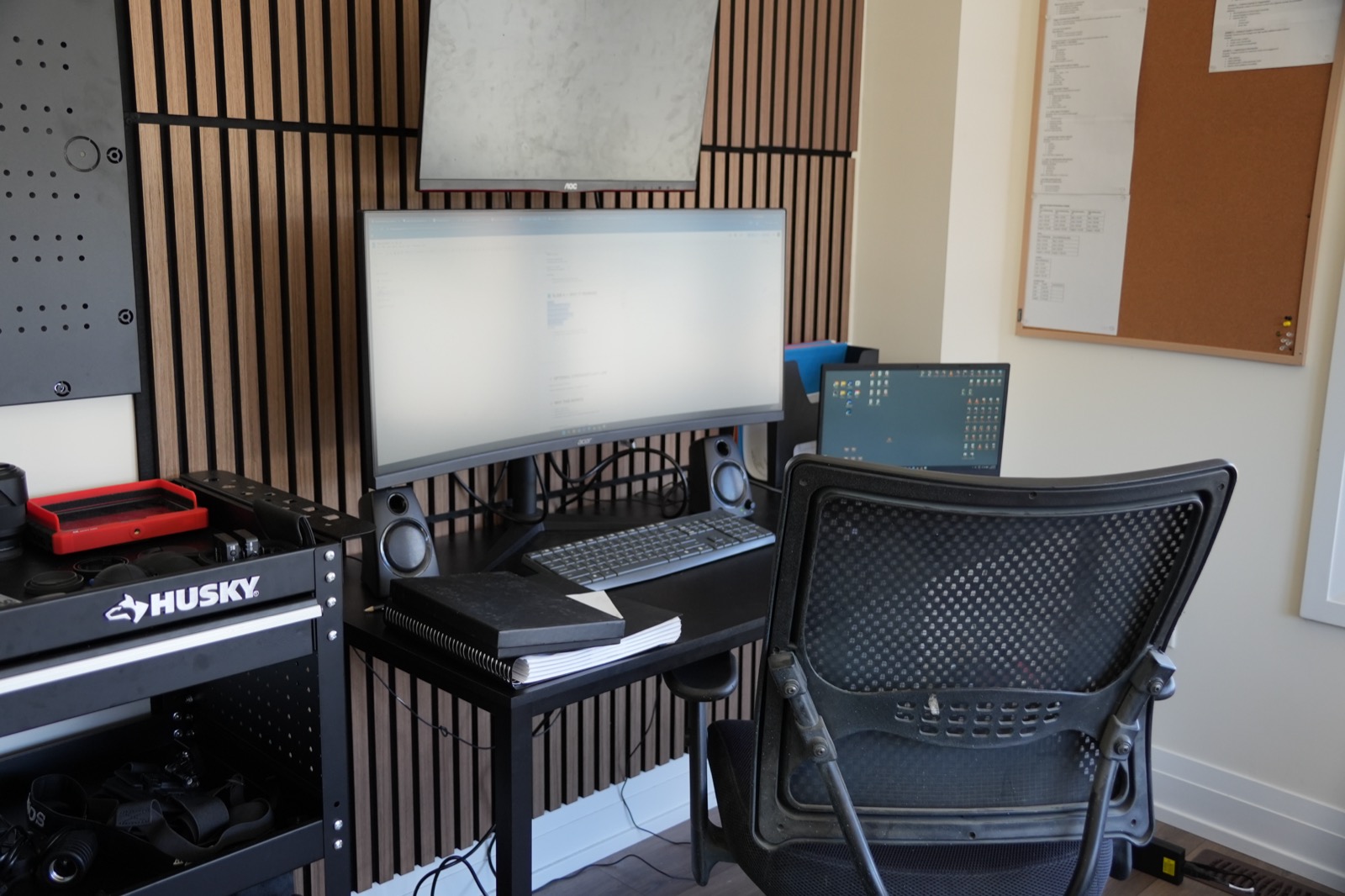
 The office
5.0 ★ on Google
5.0Google rating“Working with NewLife Marketing has been a great experience. Their team has travelled to our locations to film professional content and turn it into Meta ad campaigns focused on generating real leads for our stores. The campaigns have been profitable, the communication has been consistent, and they’re always looking for ways to improve performance and bring us more opportunities. It’s been great having a marketing team that’s willing to show up, understand our business, and put in the work. We’d highly recommend NewLife Marketing to any business looking to grow through digital advertising.”
Last step
You will talk to Cruz or Keegan, not a sales rep. If the honest answer is that you do not need us yet, that is what you will hear, and you keep the plan either way.