
The Growth Partner System
The Growth Partner System: How We Run Marketing And Sales Together
The full breakdown of the system behind every Growth Partner engagement: what runs, in what order, how it scales across four levels and why each part is there. This is how we work, not a sales page.
The system on one page
One Set Of Research. Every Surface. Four Levels Of Intensity.
This is a proven system, not a custom build. The same pillars run at every level. What changes is how much of the system runs, and how hard it runs. Everything here is there because it worked on another account first.
Keywords first
Semrush research finds what your buyers actually search. Every script, ad, blog and page starts from it.
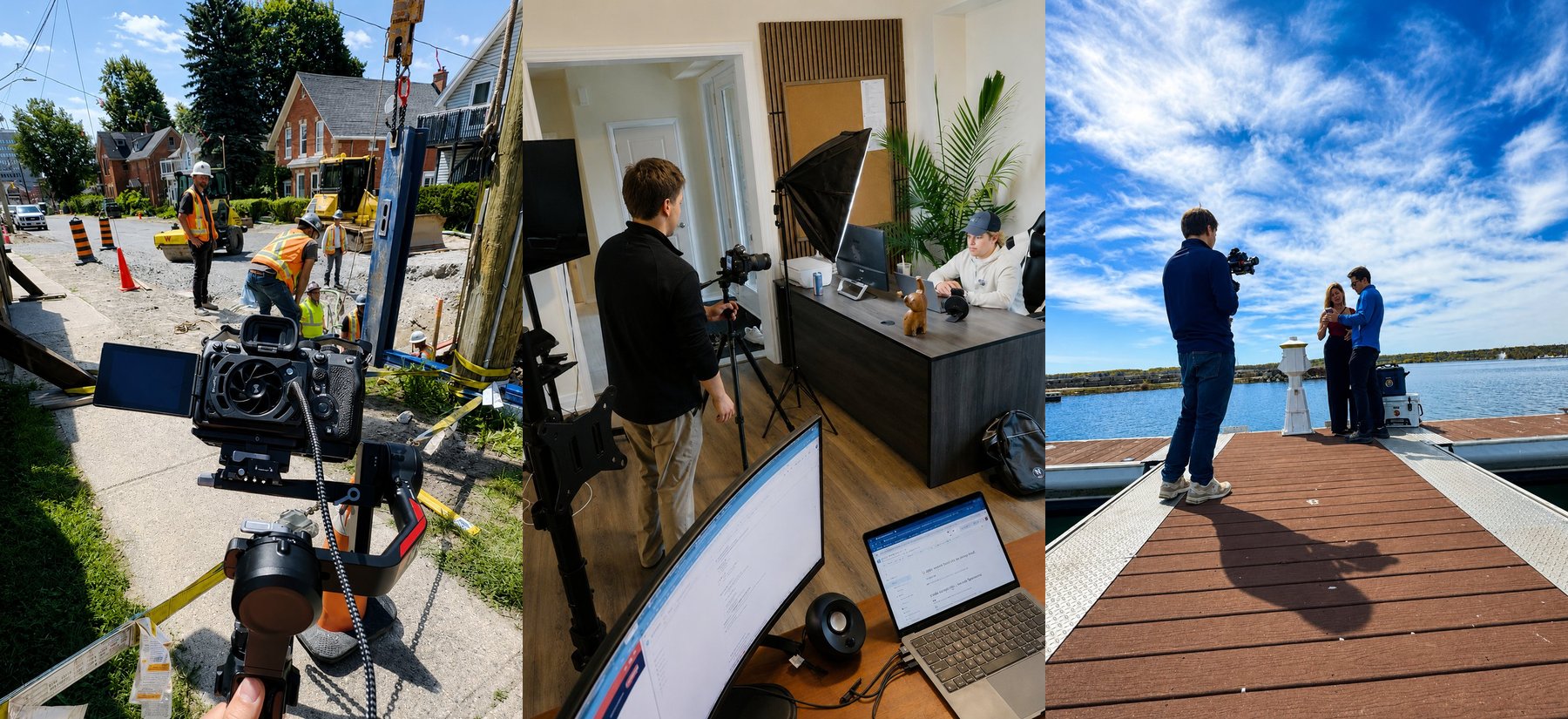
A shoot day on site
Our crew films the real business. One day covers a month of content.
Paid media
The videos run as Meta and Google ads, aimed at your area.
SEO
A blog every day, the Google profile worked daily, authority built over time.
Social and video
A thirty-day plan across the platforms that matter, YouTube included.
Your website
Taken over on day one, rebuilt if needed, then worked every month.
Email and CRM
Your own list and every enquiry, answered and followed up by a system we run.
Account warming and sales
Tracking shows who is ready. At the top level, a sales manager closes them.
Reporting you can see
Live dashboard, weekly video, weekly call, monthly review.
The four levels
Same System At Every Level. Moving Up Adds, It Never Swaps.
Read the table across to see what a level adds, and down to see how a pillar scales.
| Growth Partner 1 | Growth Partner 2 | Growth Partner 3 | Growth Partner 3 V2 | |
|---|---|---|---|---|
| Shoot days a month | 1 | 1 | 2 | 1 |
| Videos a month | 6 | 6 | 12 | 6 |
| Graphics and carousels | 26 | 26 | 60 | 26 |
| Stories | 2 to 3 a day | 2 to 3 a day | 3 to 6 a day | 2 to 3 a day |
| Platforms managed | 2 | 3, YouTube joins | 5 | 3, YouTube joins |
| Paid media | One campaign: Meta or Google | Meta and Google together | Full structure on both | Meta and Google together |
| SEO | Daily blogs, Google profile, monthly site work | Adds weekly research articles, backlink outreach, citations | Adds three new ranking pages a week | Same as Growth Partner 2 |
| Email marketing | Not included | Weekly email and automated sequences | Six sends a month and sequences | Weekly email and automated sequences |
| CRM | GoHighLevel, run by us, where the business needs one | Adds drip campaigns and custom automation | AI-native CRM | AI-native CRM |
| Account warming | Not included | Not included | Included | Included |
| Sales manager | Not included | Not included | Not included | A dedicated person, ABM and closing |
How the levels are chosen
| If the problem is | The level that answers it |
|---|---|
| Nothing is running properly, or nothing is running at all | Growth Partner 1: the full system on one engine. Most accounts begin here. |
| It works, but it is not reaching enough people | Growth Partner 2: both ad platforms, plus the parts of SEO that take years to build. |
| Reach is fine, but there is not enough output to feed it | Growth Partner 3: double the production and the full ad structure. |
| Reach is fine, but nobody is chasing and closing | Growth Partner 3 V2: a sales manager in place of more marketing volume. |
Creative and content
One Day On Site Feeds The Whole Month
Our crew comes to the business and films the real thing: the work, the team, the space, the results. Scripts are built on the keyword research, so every video is written around something people actually search. One shoot day covers the ads, the feed, the stories and the Google profile for the next thirty days. At the top level there are two shoot days, so we catch the business at two different points in the month.



| Output | Levels 1, 2 and V2 | Level 3 | What it is for |
|---|---|---|---|
| Videos | 6 a month | 12 a month | Built as ads first, then repurposed organically. Every video does two jobs. |
| Graphics and carousels | 26 a month | 60 a month | The rest of the content plan, cut for each platform. |
| Stories | 2 to 3 a day | 3 to 6 a day | Part unique from the shoot, part repurposed from blogs, reviews and recaps. |
| Google profile photos | 16 a month | 16 a month | Fresh images straight to the profile from the same shoot. |
| Content plan | 1 a month | 1 or 2 a month | A full calendar, built and approved in advance. Two where the business runs more than one brand or location. |
How the platforms scale
Level 1 manages two platforms. From Level 2 a YouTube channel joins as the third, built and run properly rather than used as a dumping ground. Level 3 manages five, each with content cut for it instead of the same post pushed everywhere. Five platforms properly fed need roughly double the output of two, which is what the extra shoot day is for.
| On the YouTube channel | Volume | Where it comes from |
|---|---|---|
| Long-form videos | 2 a month | Filmed on the shoot day. Full length, built to be watched and found in search. |
| Shorts | From the organic videos | The organic videos we already produce, published to the channel as Shorts. |
SEO and authority
SEO: Where The Whole System Gets Its Direction
SEO is not a channel sitting next to the others. We use Semrush to find the keywords that carry buying intent in your market, and those keywords run through the video scripts, the captions, the content plan, the ad copy, the blogs, the Google profile and the website pages. One set of research, pointed at every surface. It is slow to start, it compounds, and it stays yours even if the ads stop.
| What gets done | How often | Where |
|---|---|---|
| A blog post, written to rank for one search | Every day | The website |
| A miniature version of the blog posted as that day's update | Every day | Google profile |
| Keyword research, re-run to catch what has moved | Monthly | The whole system |
| Website optimisation, including embedding the long-form videos | Monthly | The website |
| Technical site audit: code errors found and fixed | Monthly | The website |
| Q&A management and 16 new photos | Always live, monthly | Google profile |
One blog, two surfaces
One blog, written once
One piece of writing a day.
The website
A new indexed page, every day.
The Google profile
Posted as that day's mini update.
Thirty blogs a month becomes thirty indexed pages and thirty profile updates, from one piece of writing a day. The research is monthly because search behaviour moves: new terms appear, old ones fade and competitors shift. A keyword set from six months ago is a plan for a market that no longer exists.
From Level 2: authority building
Rankings are not only about pages. They are about how many other sites point at yours. Two things are added at this level, and the first one is the asset the second is built on.
| Blogs | Articles | |
|---|---|---|
| The job | Collect people searching a keyword | Demonstrate authority on a topic |
| How they are built | One page, one search, written to rank | Information pulled from as many sources as we can find, compiled into one report |
| How many | 30 a month, one a day | 4 a month, one a week |
| Why they work | Volume: each one catches a different search | Depth: the kind of page other sites want to cite |
- 1
Articles give people a reason to link
Nobody links to a blog post about service pricing. They do link to original, data-fuelled research on a single subject.
- 2
Manual backlink outreach
We find sites that plausibly link to a business like yours, then ask directly, leading with the article. It goes out from your domain, from a mailbox you provide, because it is your business asking.
- 3
Directories and citations
A proper listing on every directory that makes sense: industry, local and regional, trade bodies and review platforms. A consistent name, address and phone number in many credible places is one of the strongest local ranking signals.
- 4
No shortcuts
No bought links, no link farms and no directories that exist only to sell links. A link from a site Google already trusts is worth more than ten from sites it does not.
At Level 3: three new ranking pages a week
On top of the daily blogs we publish three new pages a week built for local rankings: service pages, area pages and the combinations of the two that bring in nearby towns one at a time. Blogs catch people researching. These catch people searching for a service in a specific place, which is the search that converts.
Paid media
Meta Creates The Demand. Google Collects It.
Meta puts your work in front of people who were not looking for you yet, often enough that you are the name they know when the need arrives. Google catches the people searching today, which is the highest-intent traffic available and the fastest to convert. One without the other leaves half the market untouched. Paid media is also the only part of the system that produces in month one, and the only channel where we choose exactly who sees it.
| Level 1 | Level 2 and V2 | Level 3 | |
|---|---|---|---|
| Meta (Facebook and Instagram) | One prospecting campaign, or Google instead | 2 to 4 campaigns, prospecting and scaling | 4 to 6 campaigns: prospecting, scaling, retargeting, engagement |
| Meta ad sets and creative | From the shoot day | 2 to 4 ad sets, 4 to 7 creatives a month | 6 to 12 ad sets, 10 to 15 creatives a month |
| Google search | One search campaign, or Meta instead | Non-branded search, always live | Non-branded and branded search, always live |
| Performance Max | Not included | One campaign (Level 2 and V2) | Two campaigns, split by service line or location |
Every ad has to earn its budget
A new ad goes live
On a small daily budget, in prospecting. Nobody has seen it yet.
It works
Results at a cost that makes sense. After a few days it moves to scaling: the budget goes up.
It does not
Nothing, or too expensive. After a few days it is killed and a new ad takes its place.
Nothing gets real money until it has proven it works. We are buying information in prospecting, not results. What produces is promoted, what does not is cut quickly.
The campaign types, explained
| Campaign type | What it does |
|---|---|
| Prospecting | Cold audiences. Where every new ad starts and where most of them end. |
| Scaling | The proven winners, given real budget and left to run. |
| Retargeting | People who visited, watched or engaged and did not convert. Consistently the cheapest results in the account. |
| Engagement | Builds the warm audience that retargeting then sells to. The layer most accounts skip entirely. |
| Branded search | Defends your own name, because competitors do bid on it. Usually the cheapest traffic in the account. |
| Performance Max | Runs across Google's whole network. Your long-form videos give it real video to run, not a logo and a stock image. |
What the creative looks like


Frames from real client ad videos, filmed on location.
The website
We Take It Over On Day One
Every ad, every search result and every post ends up on the website. If it is not built properly, none of the rest works, so it stops being something you manage and becomes something we run.
| What we do | Detail |
|---|---|
| If the site is already strong | We keep it, take it over and build onto it: adding the pages that make it rank and maintaining it from there. |
| If it is not | We rebuild it, included. Not an add-on and not a separate quote, because it has to be right before anything else can produce. |
| Tracking installed | Every enquiry traced back to what produced it. |
The page grid
A page for every service
One per thing the business actually does.
A page for every area
One per town it actually serves.
Every service in every area
Ten services across ten towns is not twenty pages. It is a hundred, and each one can be found on its own.
Email and CRM
Selling To People Who Already Know You, And Catching Every Enquiry
Email reaches people who have already bought, enquired or put their hand up, so there is no ad spend between the business and that audience. Most businesses have years of addresses sitting in a system doing nothing. We turn that into revenue, and we run all of it: the writing, the design, the scheduling, the sending and the reporting.
| Email marketing (Level 2 and up) | Detail |
|---|---|
| Written, designed and sent by us | Four a month at Level 2 and V2, six at Level 3, using the photography and video from the shoot day. |
| Automated sequences | Welcome, thank-you and follow-up, always live. |
| List management | Segmentation, deliverability and list health. |
| Tracked for profit | Opens and clicks, what was clicked, and revenue per send. The last number decides whether it stays in the plan. |
The CRM, and how it grows with the level
Everything upstream produces enquiries. The CRM is where they either get worked or get lost. It is in your name, every team member is trained, we run it day to day, and there is a 24/7 line rather than a ticket queue.
| Level | What the CRM does |
|---|---|
| Level 1 | GoHighLevel, stood up in your name and run by us: pipeline, setup, a walkthrough for every team member, day-to-day management and a 24/7 support line. |
| Level 2 | Adds drip campaigns and custom automation, built to your process rather than a template. |
| Level 3 and V2 | AI-native. Calls are recorded, transcribed and summarised, and the contact record organises itself. |
Account warming (Level 3 and V2)
Knowing How Interested Someone Is Before Anyone Picks Up The Phone
When there is a sales process between interest and purchase, most teams call a list in whatever order it arrived. We set up tracking across the website, the emails and the social platforms so individual people can be recognised across all of it, and every interaction adds to a picture of how interested they are.
Website behaviour
Who visited, what they looked at, how long they stayed and how many times they came back.
Email engagement
What they opened, what they clicked and how consistently.
Social views
How many times they have seen the content across platforms: the signal almost nobody captures.
Identity matching
Cookies from email clicks and site visits tie the activity to a named person instead of anonymous traffic.
The warming data flows into the CRM and the reporting. It is also what finally makes inbound measurable: instead of knowing a campaign produced traffic, we can see which accounts that traffic belonged to and what happened to them afterwards.
| It is worth it when | It is not when |
|---|---|
| There is a sales team calling people | People buy directly off the website |
| Deals take weeks or months to close | The decision happens in one session |
| The purchase is considered or high-value | It is a low-value repeat purchase |
| You sell to businesses, not consumers | It is mass-market e-commerce |
The sales manager (Version 2)
The Version That Does Not Just Produce The Leads. It Closes Them.
Every other level produces opportunities and hands them over. Version 2 includes the person who works them: a sales manager from our team, working your pipeline, building the target list, making the connections, running the conversations and closing. It is the difference between being given a list of warm accounts and having someone whose job is turning them into customers.
- 1
Build the account list
Named companies worth winning, researched, qualified and prioritised rather than scraped.
- 2
Run the ABM campaigns
Marketing aimed at those specific companies instead of broadcast to a market.
- 3
Make the connection
Direct outreach to the right person at each account, the part most businesses never get round to.
- 4
Run the conversations
Discovery, follow-up, handling objections and keeping deals moving.
- 5
Close
The deal is signed by someone whose job is closing it.
What account-based marketing actually is
Normal marketing casts wide and waits for the right people to come forward. Account-based marketing works backwards: you decide which specific companies you want, then aim everything at them.
| Normal marketing | Account-based marketing | |
|---|---|---|
| Starts with | A market | A list of named companies |
| The ads | Reach whoever fits the targeting | Reach the people at those specific accounts |
| Success is | Volume of leads | Winning the accounts you chose |
| Best for | High volume, lower value | Fewer deals, each worth a lot |
A daily report, like any other employee
Every day the sales manager files a report into the same platform the rest of the reporting lives in, so you can see exactly what was done, the same way you would if that person sat in your office. It rolls into the weekly report and the monthly review like everything else.
| In the daily report | Detail |
|---|---|
| Accounts worked | Which named companies were touched that day and what stage each is at. |
| Connections made | Who was reached, on what channel and what came back. |
| Outreach sent | What went out, to whom and what is queued next. |
| Warming activity | New accounts added to the warming list and which existing ones moved. |
| What is next | Follow-ups due, conversations live and anything that needs you. |
See how we run account-based marketing or read the AI account research platform case study.
Reporting and support
Reporting And Support: The Part Most Agencies Do Badly
What a week looks like
Monday
A text from your account manager: the live dashboard is updated, with a quick breakdown of where things stand.
Mid-week
A phone call. Every client, every week, without exception.
Friday
A text to say the week's video report is uploaded and ready to watch.
Once a month we sit down in person with the whole team: the month's reporting walked through together, then the action plan for the month ahead. Every client is also put into a group chat with four or more people from our team, the people actually doing the work. There is no account manager relaying messages.
| In the group chat | What they own |
|---|---|
| Paid media | The campaign: structure, creative and budget. |
| Creative | Shoot days, videos, graphics and the content plan. |
| SEO and web | The site, the blogs, the Google profile and local search. |
| Account and strategy | The overall plan, the numbers and what changes next. |
The live dashboard and the weekly video
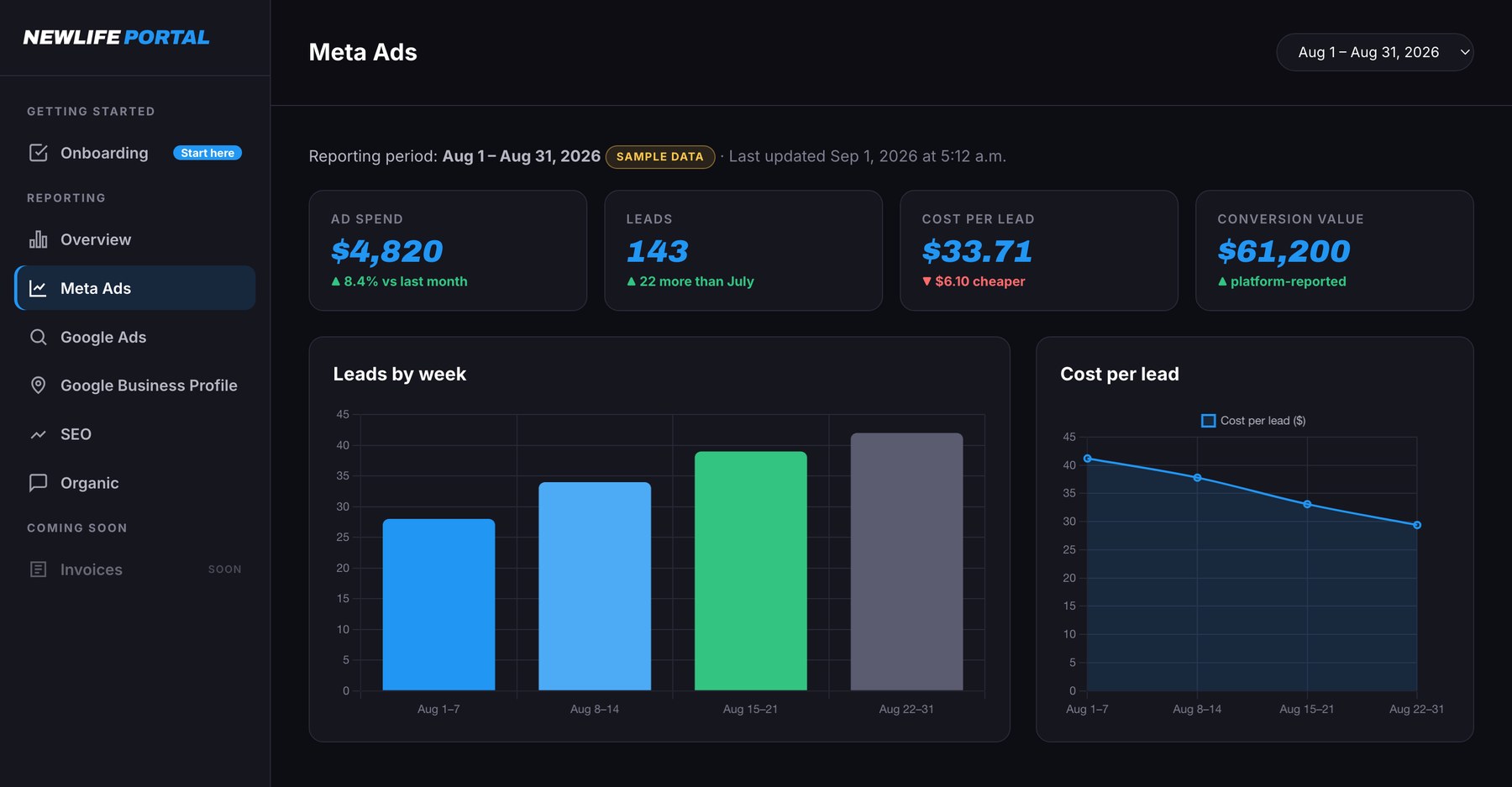
Every client is added to their own live dashboard on day one. It is not a monthly PDF that arrives and gets filed: new numbers across every channel land every Friday.
- 1
Everyone logs a daily report
Every team member records what they did for each client.
- 2
The week is pulled together
The account manager compiles it every Friday and builds the visuals.
- 3
A video walkthrough is recorded
45 seconds to 2 minutes: their face in the corner, their screen showing the actual work. Not a slide deck.
- 4
It lands on your dashboard
Saved under Reports, every week kept, so you can go back through the whole history of the account.
What we report, and what we do not
| We report | We do not report |
|---|---|
| Leads, calls, bookings and sales | Impressions presented as results |
| What each channel cost to produce them | Follower counts as the headline |
| Search movement: rankings, pages and traffic | A vanity spike framed as a trend |
| What we are changing next month, and why | Only the metric that happened to go up |
Questions
Before You Ask
What is the Growth Partner System?
Our full-service model. One set of keyword research feeds a monthly shoot day, paid media, daily SEO, a rebuilt website, email, a CRM we run and reporting you can see, delivered at four levels.
What changes between the levels?
How much of the system runs and how hard it runs. Levels 1 to 3 build on each other, so moving up adds and never swaps. Version 2 is a separate fork that adds a sales manager instead of more marketing volume.
Which level does a business start at?
It depends on the problem. If nothing is running properly, the first level. If it works but is not reaching enough people, the second. If reach is fine and more output would turn into revenue, the third. If reach is fine and nobody is closing, Version 2.
Do I have to supply the photos and video?
No. We come to you and film. One shoot day covers a month of content, two at the top level.
Do I need a website or a CRM first?
No. We take over the website on day one and rebuild it if it is not good enough, and where the business needs a CRM we set it up in your name and run it.
Who pays for the ad spend?
You do, directly to Meta and Google. It never sits inside the management fee, and each level has a ceiling on how much we will manage.
How do I see what you are doing?
A live dashboard, a written and video report every week, a weekly call, a Monday and Friday text, a group chat with the team and a monthly in-person review.
Want To See Which Level Fits?
Talk to us about where your business is today and which part of the system would move it most.
Leave your strategy call with a written growth plan: yours to keep, hire us or not.