
Step 1 of 5
Audit
Before anything is changed, we read what the account has actually been paying for. On a neglected account this one report explains most of the waste, and it is free to read.
 5.0 Google rating
Google Ads Management In North Bay
PPC Agency North Bay work runs on a fraction of the data a southern account has, and almost every automatic setting in the platform assumes you have more than you do.
Trusted by Ontario businesses












On this page
The whole scope, in the order it is explained below.
The size of it
Nipissing and Parry Sound districts
The second number is the one that should shape any paid proposal here. Where unpaid positions are effectively unclaimed, renting the same visibility every month is a strange purchase, and a supplier who does not say so is not looking at the market.
That does not make advertising useless. It makes it narrow: a tool for answering questions quickly and for reaching the parts of a wide catchment where a map result cannot place you.
Both of those have a natural end. The question gets answered; the catchment campaign settles into a small, steady line that needs very little attention.
Which brings the awkward part forward rather than leaving it to month seven: in a market like this, a well-run account genuinely requires less work as it matures, and the fee should reflect that.
The phrase is searched for specifically. Here is what it should contain in a market this size.
What people actually typed rather than what you asked for. In a thin market a handful of irrelevant phrases can absorb a meaningful share of a month, and nothing reports it as a problem.
The list of what you are not, growing from the report above. It is cumulative: an account two years old with no negatives has been paying for the same irrelevant clicks since launch.
Named communities rather than a radius, reviewed against where paying customers actually were. In a catchment over an hour wide a default circle is wrong in both directions at once.
What has to happen for somebody to call you between reports. Without one, the first anybody hears of a problem is a month after it started.
Google Ads management in a market this size is those four done reliably, not a weekly round of bid adjustments. Ask what happens in the weeks when nothing needs changing — the answer tells you what the fee is really buying.
What the budget is for
Neither is permanent, and both are testable.
The first is buying an answer. Does this offer land, does this page convert, which words do the people who actually enquire use. Each is settled in a fortnight for a modest sum, and each answer then directs unpaid work that would otherwise have been guesswork.
The second is reaching the catchment. A map result places you relative to where the searcher is standing, so a business in town is largely invisible to somebody searching from forty minutes out. Paid reach has no such constraint, and that is a specific job with a specific test.
Retargeting belongs inside the second. The audience is small, it has already visited, and reaching it again costs a fraction of reaching a stranger — and in the small accounts we are shown it is the most common thing missing entirely.
Agree what would end a test before it starts: a number, a date, or an answer. Without one of those three nothing ever switches off.
What it can learn
Everything automatic in the platform is built for accounts with far more evidence than yours will ever produce, and that is the central fact about running one up here.
A southern account gets hundreds of conversions a month and can be left to work things out. An account with eight has a sample so small that two good weeks and two bad ones are indistinguishable from luck, and a system told to optimise on it will chase noise with real money.
So the time base changes. Judge a change over a quarter, not a week. A week on a small account tells you nothing at all, and acting on it is how an account gets churned into something nobody can read.And the control changes. Manual bidding for far longer than any guide recommends. Exact match on the handful of searches that genuinely matter. A short, deliberate list of what to block rather than a machine deciding.What a small account is genuinely good at is a narrow question with a clear answer: does anybody here search for this at all, and what does one of them cost? Six weeks and a modest budget answers that properly, and the answer is worth having whether it is yes or no.What it is not good at is being left alone to find its own way. That is the setting that quietly spends a northern budget on a southern strategy.
What goes wrong
A correctly targeted account here will not absorb a large budget, and that looks like failure in a monthly report.
Somebody reads the report, sees unspent budget, and reasonably proposes broadening the match types or the radius to use it. The budget then gets spent, the clicks arrive, and the enquiries do not.
In this geography there is a second version: widening until the radius covers communities you cannot profitably reach. Those clicks are real and the jobs are not, because the travel arithmetic makes them unprofitable even when they convert.
There is a quieter version too, and it survives every review: automated campaign types choosing their own placements and geography inside whatever boundary they are given. In a thin market they will find the cheapest impressions available, and the cheapest impressions here are the ones nobody wants.
The better response is to accept the ceiling. Let the campaign spend what the market contains, and put the remainder into the profile and the pages, which keep earning after the card is declined.
The reporting habit that prevents all three versions is the same one: read the search terms and the geographic report side by side, monthly, and ask one question of each line. Would I have chosen to pay for this. Anything that fails that test becomes a negative keyword or an excluded location that week, and the account gets tighter every month instead of looser.
The pattern is almost always the same and it is almost never dramatic. Somebody sets it up carefully, it works, and then nobody reads it again. Six months later the words people use have moved, two competitors have arrived, a seasonal line is still running out of season, and the budget is going somewhere nobody chose.
None of that produces an alarm. The account carries on reporting clicks and impressions, both of which look healthy, while the thing the business actually cares about quietly gets more expensive every month.
Our scope
Narrow, and shaped to a market that does not need much advertising.
We build and run Google and Meta accounts against cost per enquiry, write the pages the ads point at, and set up the tracking that connects an enquiry to its source. We manage over $70,000 a month in advertising spend for Ontario businesses and the owner runs the paid media personally.
We do not sell percentage-of-spend management, because it pays us to recommend the opposite. We are in Minesing, several hours south, which changes nothing for running an account and matters only for filming.
The media budget, which goes to Google, and the management fee, which goes to the agency. A single number a month tells you neither, and an agency taking a percentage of spend is paid more for spending more. Ask for both figures in writing, ask what happens to the account if you leave, and ask whose name it is in.
Next step
A fair question, and one most agencies will not answer against their own interest.
Work out what one new customer is worth to you over everything they will ever buy. Then open the account and find what one enquiry currently costs, and what share of enquiries become customers. Three numbers, one afternoon.
If an enquiry costs more than a customer is worth, no amount of management fixes that, and anybody telling you otherwise is selling you a fee. If it costs a fraction, the budget is probably too small rather than too large.
Send us the account and we will work out all three with you and say which of those two you are in, whether or not you ever want us to touch it.
How it works
Five steps, and the first one costs nothing but reading.
Step 1 of 5
Before anything is changed, we read what the account has actually been paying for. On a neglected account this one report explains most of the waste, and it is free to read.
Step 2 of 5
Campaigns split so that a budget decision is possible: by what you sell, by what it is worth, and by where it is worth it. An account that cannot be turned down in one place cannot be managed.
Step 3 of 5
A conversion is a booked job or a sale, not a click on a phone number. Tracking is verified against what the business actually received before a single bid is changed.
Step 4 of 5
Starting on the searches with the clearest intent and the tightest match, then widening deliberately once there is evidence rather than hope.
Step 5 of 5
Every search term the account paid for, read weekly and sorted: promote it, block it, or leave it. This is most of what separates an account that improves from one that drifts.
Proof first
Every number on this site came from paid media or production work, with the client named. There is no traffic graph here and you should be wary of them elsewhere.
A Portuguese grill that came to us with almost no online presence.
Read the case study →Named clients, real figures, and what each one was spending.
See all case studies →That account was not run in North Bay, and we are not going to imply otherwise. It is published, named and checkable, which is more than a logo wall offers. Ask any agency you shortlist for the cost per booked job before and after, and ask who counted it.
The person on your account
Founder & CEO · Head of Operations & Paid Media — NewLife Marketing
Runs your strategy call, builds and manages your paid media accounts personally, and owns the monthly numbers you will be shown. On your calls you talk to Cruz or Keegan: never a rep.
Straight answers
Straight answers before you ever book a call.
Narrowly, and with an end in sight. The unpaid positions in this market are effectively unclaimed, so renting the same visibility every month is a strange purchase. A budget earns its place answering a question in a fortnight and reaching the parts of the catchment a map result cannot place you in.
The search terms report read, negative keywords maintained from it, a hand-drawn boundary reviewed against where paying customers were, and a named trigger for contacting you between reports. Ask what happens in the weeks when nothing needs changing — that answer tells you what the fee buys.
Almost never. An underspending account in an eighty-search cluster is usually a correctly targeted one that has run out of relevant searches. Widening spends the money on people who were not looking for you, and here it also reaches communities the travel arithmetic makes unprofitable.
From three numbers: what a customer is worth over the relationship, what share of enquiries convert, and the maximum defensible cost per enquiry that follows. With those the budget is arithmetic. Without them any figure is borrowed from a business that is not yours.
Why NewLife
Everything we do runs on one system we call The Film-to-Funnel System: in-house film → paid ads → landing page → CRM follow-up → optimize. Here is how that stacks up against doing it yourself or hiring a typical agency.
| In-house | Typical agency | NewLife | |
|---|---|---|---|
| Creative | You film it on a phone | Outsourced or stock footage | Our in-house cinema crew, filmed on-site |
| Who does the work | You, between running the business | A junior account manager | Cruz and the senior team, directly |
| The system | Disconnected tools that don't talk | Ads, then hands-off | Film → ads → landing page → CRM, one connected system |
| Your accounts & data | Yours, but no time to run them | Often held hostage | Always yours - you keep everything |
| Follow-up | Manual, when you remember | Rarely their problem | Automated speed-to-lead in the CRM |
| Local knowledge | You know your market | A national, generic playbook | Real local research for every market you target |
Where to go next
Come say hi
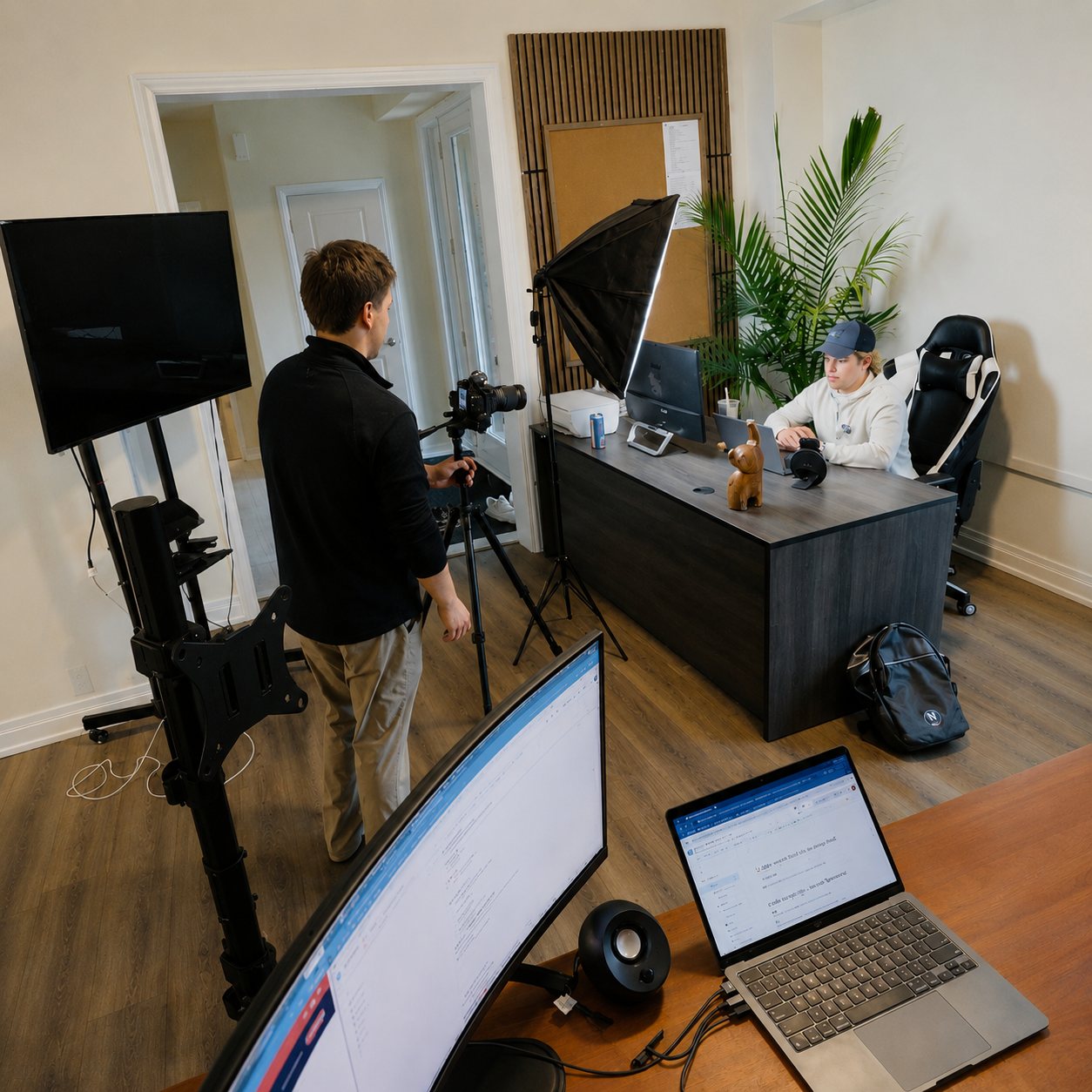
The office and the studio are in Minesing, just west of Barrie. Come and sit in it, see what is actually on the screens, and ask the person who would be on your account what they would do first.



 The office
5.0 ★ on Google
5.0Google rating“Working with NewLife Marketing has been a great experience. Their team has travelled to our locations to film professional content and turn it into Meta ad campaigns focused on generating real leads for our stores. The campaigns have been profitable, the communication has been consistent, and they’re always looking for ways to improve performance and bring us more opportunities. It’s been great having a marketing team that’s willing to show up, understand our business, and put in the work. We’d highly recommend NewLife Marketing to any business looking to grow through digital advertising.”
Last step
You will talk to Cruz or Keegan, not a sales rep. If the honest answer is that you do not need us yet, that is what you will hear, and you keep the plan either way.